Zone numbers are additive. If portions of a constant plate variety occupy more than one zone, identify each affected zone and add the zone values.
Example: Doubling "in and below the 'CAN' of Canada".
In CAN is Zone 8.
Below CAN, (within the white inner oval) is Zone 16.
A variety showing both is recorded as 8 + 16 = Zone 24.
Inner-oval rule: Any mark within the white inner oval, or in the coloured portrait field enclosed by it, is Zone 16.
The “Zone” number shows where on the stamp a variety appears. If varieties occur two or more areas, the numbers for those areas are added together to create its Zone. Click any Zone number below to see how the system works. For a variety to be part of a Zone, it must be at least partially located in that coloured area.
If your stamp is already listed on the site, finding it should be quick and easy. Just follow these four steps:
Click the Search link at the top of any page.
Use the options in the left sidebar to specify your search paramaters.
Try Denomination, CPV Type, Format, and Zone to start—these are often enough—but feel free to add more filters for more specific results.
When you’re ready, click Submit Search near the bottom of the left sidebar.
You will see a list of all plated Admirals that match your criteria. Only 15 results show at a time, but you can access additional pages using the navigation bar at the bottom of the page. To view a stamp in detail, just click on it. Clicking outside the stamp’s lightbox will bring you back to your search results.


Randal Van Someren created thse composite views of the zone system diagrams.
He suggests that another perspective might help others who find this concept a bit troublesome.
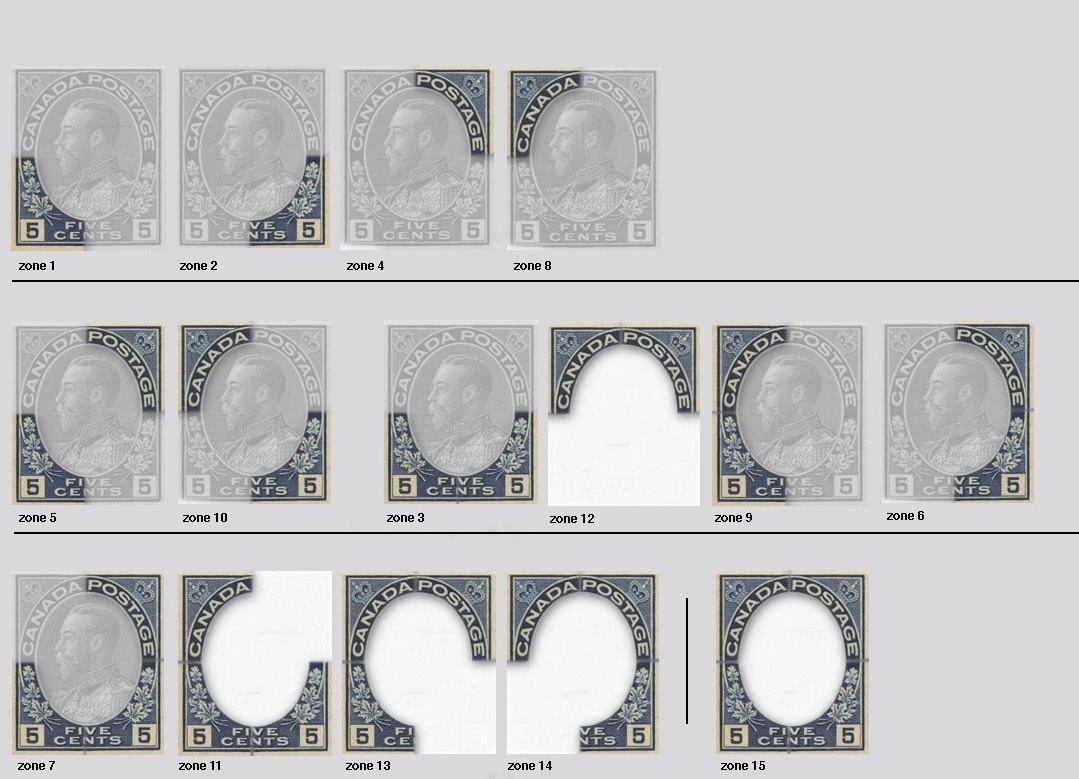
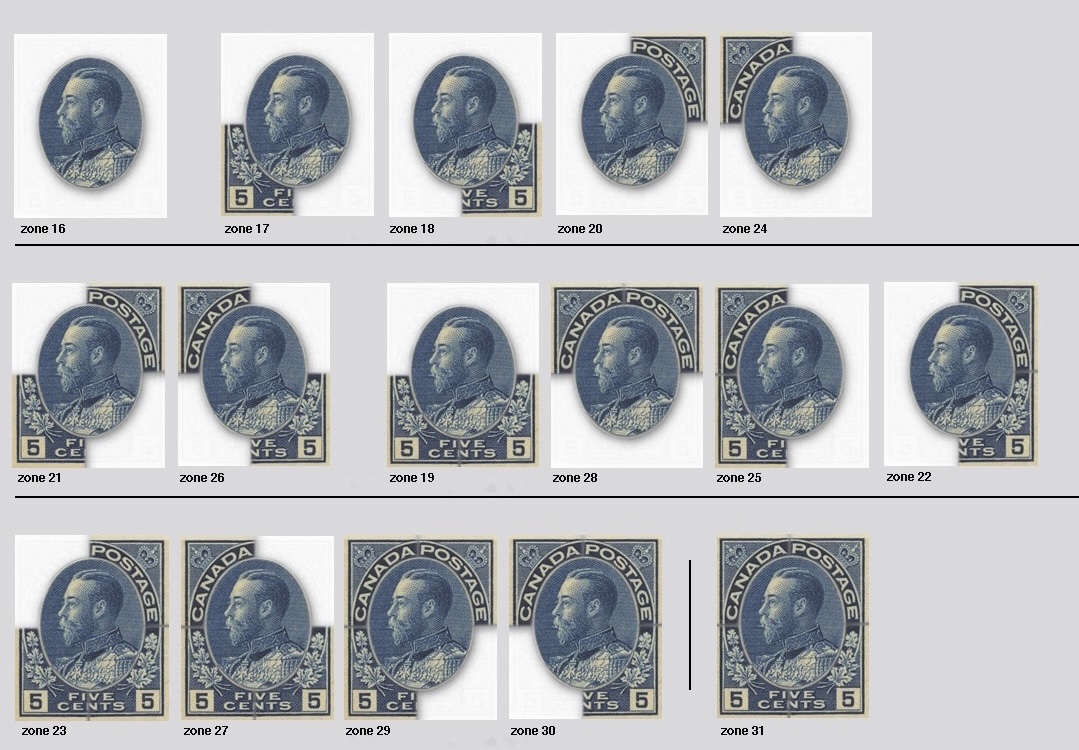
FAQ
-
A Zone number identifies where a constant plate variety appears on an Admiral stamp. When a variety has marks in more than one coloured area, add the number for each affected area to obtain the recorded Zone.
-
Identify each separate affected feature and assign its zone from the diagram. Add those zone values together; do not choose just the one area that seems closest to the whole variety.
-
Doubling in the letters 'AGE' of Postage is in Zone 4, the upper-right area of the stamp. A variety confined to those letters is therefore recorded as Zone 4.
-
Doubling below 'CAN', when it is within the white inner oval or its coloured area, is in Zone 16. The inner oval and the coloured portrait oval are always Zone 16.
-
Record the variety as Zone 24. Doubling in CAN is Zone 8, and doubling below CAN in the white inner oval is Zone 16; therefore 8 + 16 = 24.
-
Yes. Any mark located within the white inner oval, including any mark in the coloured area enclosed by that oval, belongs to Zone 16. This remains true even when the mark is directly below lettering that belongs to another zone.
-
No. A CPV may have marks in more than one zone. Assign a zone to every affected feature, then add the numbers to produce the final Zone number. Each Zone number indicates a unique area or areas of the stamp.
-
Zone numbers help narrow a search to CPVs appearing in the same design area. For best results, combine Zone with denomination, CPV type, and format, then compare the listed image carefully with the stamp.